

Repair, Recoat, or Replace: How to Think It Through
Short answer: Repair makes sense when the damage is in one area, the material under the surface is still dry, and the rest of the roof has life left in it. Replacement makes sense when problems are spread across the roof, the underlayment or deck is failing, or you are paying for the same kind of repair over and over. On an Arizona foam or flat roof there is a third option, a recoat, that often sits between the two.
Most homeowners in Phoenix and Scottsdale only think about their roof when something goes wrong: a stain on the ceiling, a tile in the yard, a coating that looks chalky and tired. The first question is always the same. Can this be fixed, or is it time for a new roof?
There is no single answer, because a tile roof in Scottsdale, a foam roof in central Phoenix, and a shingle roof in Mesa fail in different ways and get fixed in different ways. What follows is the set of questions a good roofer actually works through, so you can follow the reasoning when you get an estimate. If you want someone to walk the roof and give you a straight answer, our roof repair page explains how we do that.
The four questions that decide it
1. How much of the roof is affected?
This is the biggest one. One cracked tile, one lifted seam, one failed pipe boot, one soft spot in the foam: these are repairs. Damage that shows up in three or four unrelated places is telling you something about the whole roof, not about one spot.
2. What condition is the layer underneath in?
The surface you can see is rarely what keeps the water out. On a tile roof the real waterproofing is the underlayment beneath the tile, and when it has baked brittle in the Arizona sun the tiles can look perfect while the roof leaks. On a foam roof the coating is the sacrificial layer and the foam beneath it is the roof. If the underlayment is cracking across the roof, or the foam is wet, a surface repair is a patch on a problem that is already everywhere.
3. How many times has this roof been repaired already?
Pull out the old invoices if you have them. One repair in a roof’s life is normal. A repair every year or two, in different spots, means the repairs are adding up and you still have an old roof at the end of it. The pattern matters more than any single repair.
4. How old is the roof, relative to its type?
Age on its own does not decide anything, but it sets the context. Every roofing material has a working life, and Arizona heat and UV shorten it. A roof near the end of its expected life with one problem is still a repair, but it is a repair you make knowing replacement is coming, and it is fair to ask whether the money is better spent on the new roof. Be wary of anyone who quotes a lifespan without looking at the roof.
The recoat option on foam and flat roofs
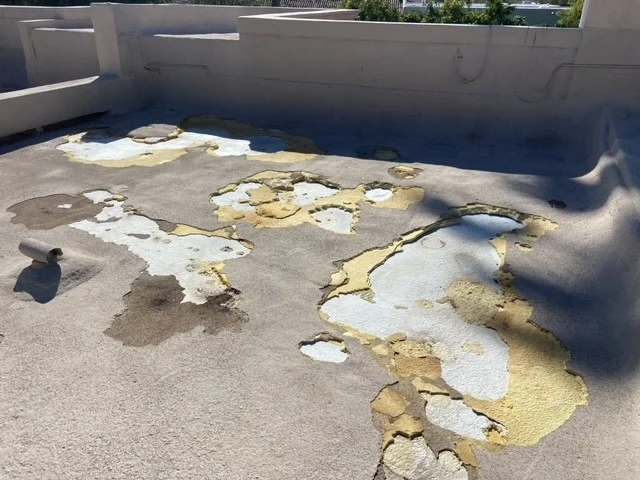
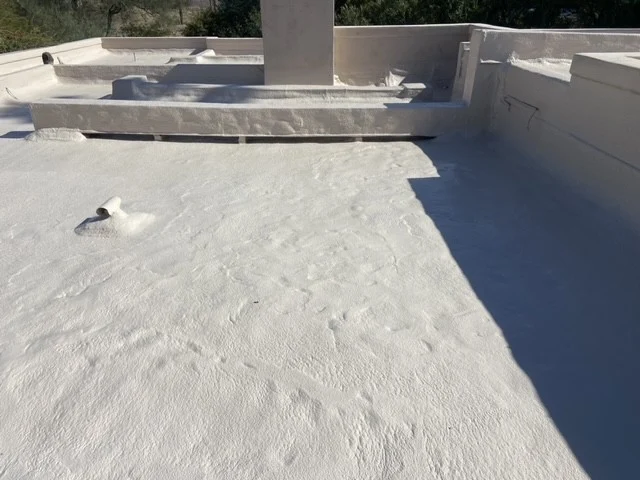
A foam roof is built in two layers: the spray foam that provides the slope, insulation, and seal, and the elastomeric or silicone coating that protects the foam from the sun. The coating is the part that wears. The foam, as long as it stays protected and dry, keeps doing its job. So a foam roof that looks tired on top is often a candidate for a recoat: repair any damaged areas, confirm the foam is dry, and apply a fresh topcoat over the whole roof.
A recoat makes sense when the foam is sound and dry and the coating is thin, chalky, or cracked without large areas of bare foam or deep ponding. It does not make sense when moisture has gotten into the foam, since coating over wet material traps the water in and the roof keeps failing underneath a fresh surface. Our roof coatings page covers the coating systems we use, and our spray foam roofing page explains the full system for roofs that need more than a recoat. Foam roof makeovers from Circle G carry a 5-year warranty.
Tile roofs: the tile is rarely the problem
Tile roofs are everywhere in Scottsdale and north Phoenix, and they confuse the repair or replace question more than any other type. Concrete and clay tile hold up well to the sun. What fails is the underlayment beneath it, which dries out and cracks after years of heat. When a tile roof leaks, the usual fix is to lift the tile in the affected area, replace the underlayment and flashing, and reset the same tile. That is a repair.
When the underlayment is failing across the whole roof, the honest answer is a full underlayment replacement, which reuses most of your existing tile. The deciding factor is how widespread the underlayment failure is, not how the tile looks. Our tile roof repair page covers both. And please do not walk a tile roof to check it yourself. Tile cracks underfoot, and the walk itself causes damage.

Signs that point toward repair
- The leak or damage is in one identifiable spot, often at a penetration, valley, or edge
- The underlayment, foam, or deck in the surrounding area is dry and sound
- The roof has a good amount of life left for its type
- The cause is something specific and fixable: a cracked tile, a failed pipe boot, a lifted seam, a blocked scupper
“However the Circle G team, provided a no-nonsense proposal to re-foam certain problem areas and completely resealed the entire roof at a very reasonable cost. The roof has been leak-free since.”
Signs that point toward replacement
- Leaks or damage in several unrelated areas
- Underlayment that is brittle and cracking wherever it is exposed, or foam that is wet in more than one place
- A deck that feels soft or has sagged
- A roof near the end of its expected life that would need major work to keep going
How to get a straight answer
Ask for an inspection that looks at the whole roof, not just the spot where the leak showed up. Ask to see photos of what was found and to have the condition under the surface explained, not just what is on top. A good roofer will tell you when a repair is the right call, even when a replacement would be a bigger job for them, and a written estimate that separates the two options with the reasoning for each lets you decide with the facts in front of you.
Not sure which way to go?
Circle G Roofing inspects tile, foam, and flat roofs across Scottsdale, Phoenix, and Maricopa County, and we will tell you plainly whether your roof needs a repair, a recoat, or a replacement. We are family-run and handle emergency leaks 24/7.
Call Circle G Roofing at (602) 791-6415 or request an inspection online.
Frequently Asked Questions
Should I repair or replace my roof if it is only leaking in one spot?
How many repairs are too many before replacing a roof?
Can a foam roof be recoated instead of replaced?
Do I need to replace a tile roof if a few tiles are broken?
Talk to Circle G Roofing
Family-run roofers serving Scottsdale, Paradise Valley, Cave Creek, Carefree and the Phoenix area.


