

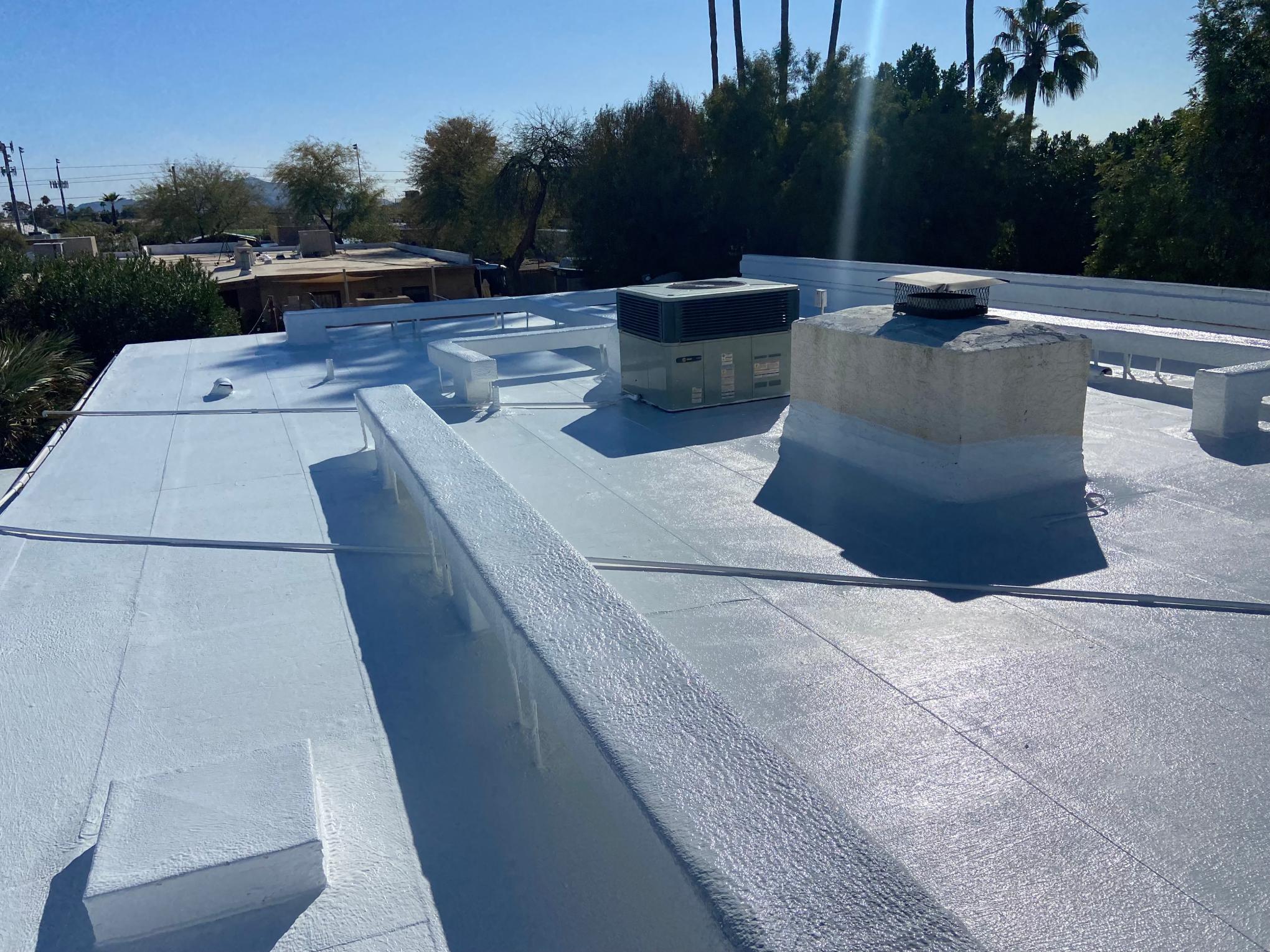
Short answer: Flat roof repair starts with finding the real failure point, which is rarely where the ceiling stain is. On Arizona low slope roofs the usual culprits are failed seams and flashing, cracked parapet walls, blocked scuppers causing ponding water, blistering in the membrane, and coating that has weathered past its service life. A genuine repair is possible when the deck underneath is still dry and the failure is localized. Once moisture is in the insulation, a patch just moves the leak.
Almost no flat roof is actually flat. It is built with a slight pitch, often a quarter inch per foot, so water heads for a drain instead of sitting still. When people say their flat roof is leaking, what usually happened is that the drainage stopped working or the surface protecting the deck gave up.
Here is what actually goes wrong on low slope roofs in the Valley, and how to tell what you are dealing with.
What fails on an Arizona flat roof
Ponding water
Water that is still sitting on the roof 48 hours after rain is ponding, and it is a problem rather than a curiosity. Standing water accelerates the breakdown of almost every roofing material, magnifies UV exposure, and gets heavy fast. A blocked scupper, a crushed drain, a sagging deck, or a poorly planned addition are the usual causes.
After a monsoon storm dumps an inch in twenty minutes, blocked drainage shows up immediately.
Seam and flashing failure
Most flat roof leaks are not holes in the middle of the field. They are at the edges and the interruptions: where the roof meets a parapet wall, around an air conditioning curb, at vent penetrations, at pitch pans, and along seams between membrane sheets.
Those are the spots that move. Everything on a roof expands and contracts, and the joints take the strain.
Parapet wall cracks
Very common on Southwestern architecture, and frequently missed. The parapet is the low wall around the roof edge. Stucco cracks, the cap flashing loosens, and water gets in behind the wall rather than through the roof surface. The stain then appears well away from the actual entry point, which is why chasing the stain wastes so much time.
Blistering and delamination
A blister is trapped moisture or air lifting the membrane away from what is under it. Arizona heat drives this hard. A roof surface can reach far above the ambient air temperature, and whatever is trapped underneath expands. Small blisters are monitored. Open ones are an entry point.
Coating that has reached the end of its life
Foam and coated roofs are not install-and-forget. The coating is the sacrificial layer that protects the foam from ultraviolet light, and UV is relentless here. When it thins, chalks, or wears through at the high traffic spots, the foam underneath starts degrading and the clock speeds up.
This is the most common thing we find on Scottsdale flat roofs, and it is also the most preventable. There is a fuller breakdown in our piece on signs you need roof recoating.
Foot traffic damage
Air conditioning units live on flat roofs. So HVAC technicians walk on flat roofs, often without walk pads, sometimes dropping tools. A surprising number of leaks we trace start as a puncture near a mechanical unit.
Why Arizona is harder on low slope roofs
Three forces, and they compound.
Ultraviolet light. The Valley gets punishing UV for most of the year. UV is what degrades exposed roofing chemistry, and it never takes a season off here the way it does in milder climates.
Thermal cycling. A roof surface that hits well over 150 degrees in the afternoon and drops sharply overnight expands and contracts every single day. That daily movement is what opens seams, fatigues flashing, and cracks parapet stucco. It is not one dramatic event, it is thousands of small ones.
Monsoon. Then, after months of baking, the roof takes a violent downpour with wind-driven rain. Anything that thermal cycling loosened over the summer gets tested at once. This is why so many Valley leaks are discovered in July and August on damage that was actually done in May and June.
Dust matters too. Blown dust settles into drains and scuppers, and a partially blocked scupper does not announce itself until the water has nowhere to go.
Repair, recoat, or replace
The honest answer depends on how much water is already in the system, not on how bad the roof looks.
| Situation | Usually the right call |
|---|---|
| Localized leak, deck and insulation still dry | Repair. Fix the failure point, done |
| Surface weathered or coating thin, no active leaks, substrate sound | Recoat. Restores the protective layer at a fraction of replacement |
| Multiple leaks across different areas, coating gone | Recoat after repairs, assuming the substrate tests dry |
| Wet insulation, saturated deck, or widespread saturation | Replace. A coating over wet material traps the water in |
| Deck itself is structurally compromised | Replace, and the structure gets addressed first |
The step nobody should skip is confirming whether moisture has got into the layers under the surface. A roof can look fine from a ladder and be saturated underneath. If a contractor quotes a recoat without establishing that the substrate is dry, that is worth questioning, because sealing water inside a roof assembly is how a small problem becomes a tear-off.
What a proper flat roof repair involves
- Find the actual entry point, not the stain. That means tracing uphill from where the water appears, checking penetrations and terminations, and looking at the parapet as seriously as the field.
- Check whether the substrate is wet. This decides everything that follows.
- Repair the failure. Reseal or rebuild the seam, flashing, pitch pan or penetration properly rather than smearing sealant over it.
- Address the drainage that allowed water to sit there. Fixing a leak while leaving the scupper blocked buys you until the next storm.
- Protect the repair. Tie the repair into the surrounding surface so the patch is not itself a new seam waiting to fail.
That fourth step is the one most often skipped, and it is the reason some roofs get repaired repeatedly in the same spot.
How Circle G approaches flat roofs
We are a foam and coatings specialist, and we will say plainly that this shapes what we recommend. For most Valley low slope roofs, a spray foam roofing system with a protective topcoat solves the two problems at once: the foam is self-flashing so it seals around every penetration without seams, and it adds real insulation on a roof surface that is otherwise cooking.
For an existing roof that is sound but weathered, a silicone roof coating or polyurea elastomeric coating restores the protective layer without a tear-off.
What we will not do is sell you a recoat over a wet roof. If the substrate is saturated, coating it is a way to hide the problem for a season, and we would rather tell you that up front.
Circle G is family run, we have been doing this in the Valley for more than 20 years, and foam roof makeovers carry a 5-year warranty.
Frequently asked questions
How do I know where my flat roof is leaking?
You usually cannot tell from inside. Water travels along the deck and down structural members before it shows on a ceiling, so the stain is often well away from the entry point. Finding it means getting on the roof and working uphill from the interior evidence, checking penetrations, terminations and the parapet.
Can a flat roof be repaired, or does it need replacing?
Most can be repaired, provided the failure is localized and the material under the surface is still dry. The deciding factor is moisture in the insulation and deck, not the age of the roof or how weathered it looks.
Why does my flat roof leak only in heavy rain?
Usually drainage rather than a hole. A small failure that sheds light rain gets overwhelmed when water backs up behind a blocked scupper or ponds in a low spot. It can also point to wind-driven rain getting behind flashing or a parapet cap, which only happens in a storm.
How often does a foam roof need recoating?
It depends on the coating, its thickness, and the exposure, but planning on inspection every few years and recoating before the topcoat wears through is the way to keep a foam roof going indefinitely. The recoat is what protects the foam, so letting it go is what shortens the roof’s life.
Is ponding water on a flat roof always a problem?
Water still sitting more than about 48 hours after rain, yes. It accelerates material breakdown, intensifies UV exposure, and adds significant weight. Occasional brief puddling that drains away is normal.
Should I get the roof looked at before monsoon season?
It is the single most useful piece of timing. Most storm-season leaks are pre-existing damage that the storm finds. Catching a lifted seam or a blocked scupper in May is a small job. Finding it in August, from the inside, is not.
Get your flat roof looked at
If your low slope roof is leaking, ponding, or just has not been inspected in a few years, we will get up there, find out what is actually happening, and tell you whether it needs a repair, a recoat, or something more.
Call Circle G Roofing at (602) 791-6415 or toll free at (877) 239-1274, or request an inspection. We handle emergency leaks 24/7 and cover Scottsdale, Paradise Valley, Cave Creek, Carefree, Phoenix and the wider Maricopa County area.
If it is a tile roof you are worried about rather than a flat one, our tile roof repair team covers that side.